

Seawater Desalination Equipment: Seawater Intake for SWRO — Open Intake vs. Beach Well Intake
For an SWRO project, seawater intake is not simply a pipeline connecting the ocean to the desalination plant. The intake determines the physical, biological, and chemical characteristics of the water entering pretreatment, which then affects membrane fouling risk, pretreatment requirements, pump operation, cleaning frequency, and long-term system stability. Seawater Desalination Equipment should therefore be specified together with a clearly defined intake design and raw-water quality envelope.
An SWRO plant begins operating from the point where seawater enters the intake system. Before the water reaches the high-pressure pump and RO membrane, the intake structure must provide a controlled and reliable feed stream while limiting the introduction of debris, suspended solids, organisms, algae, and other contaminants.
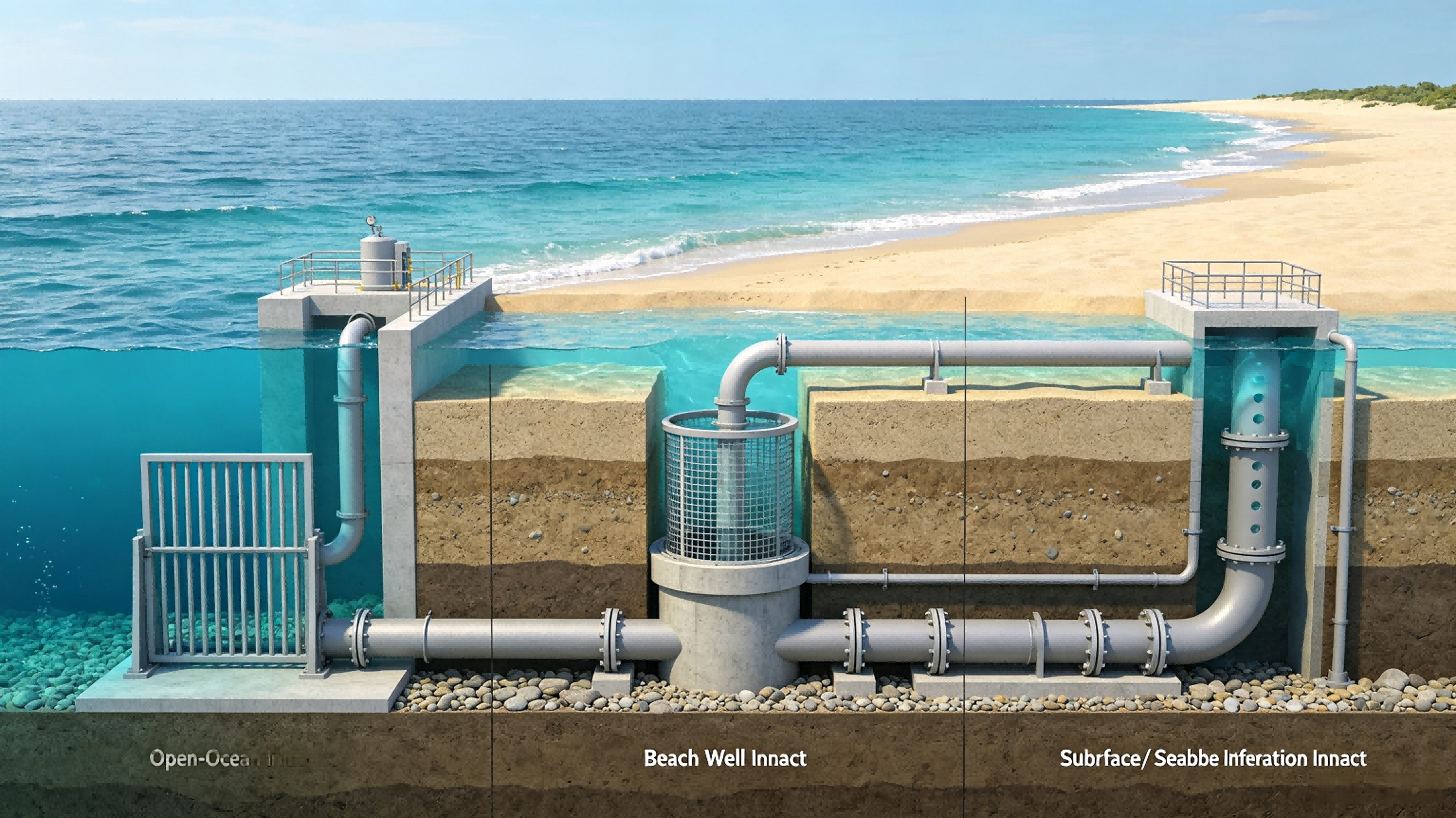
Common seawater intake configurations include open-ocean screened intakes and subsurface systems such as beach wells and offshore radial collector wells. These configurations are recognized as distinct intake options in desalination process studies.
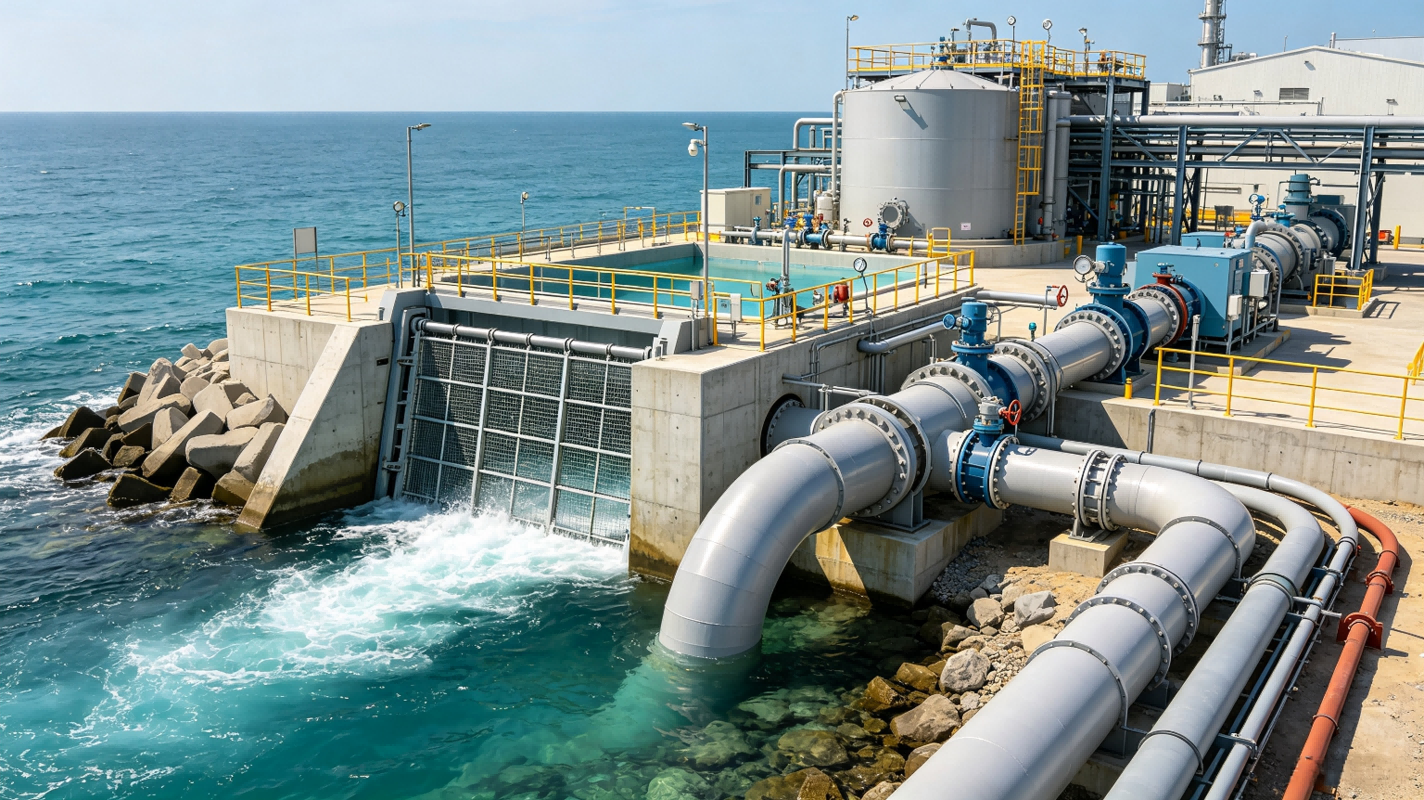
An open intake normally draws seawater directly from the marine environment through an intake structure, pipeline, or screened system. Because the water is collected directly from the ocean, its quality can reflect short-term and seasonal changes in turbidity, suspended solids, algae, microorganisms, natural organic matter, oil contamination, and other constituents.
A beach well operates differently. Instead of taking water directly from the open water column, the well draws seawater through permeable beach or coastal geological formations. As water moves through the surrounding sediment, part of the suspended and biological load can be retained naturally before the water reaches the well.
Subsurface intake can also use seabed or offshore collector configurations. In these systems, the intake is located beneath or within the seabed formation, allowing the geological medium to provide a degree of physical filtration before the water enters the treatment system.
This difference changes the design problem. With an open intake, the engineering team must usually characterize the marine environment and then design pretreatment to handle the measured raw-water quality. With a subsurface intake, the engineering team must additionally characterize the geology, hydraulic conductivity, well yield, seawater movement, clogging potential, and the stability of the subsurface source.
The intake therefore becomes part of the pretreatment strategy. A change in intake configuration can change the required screening, coagulation, flotation, media filtration, ultrafiltration, cartridge filtration, or other treatment stages downstream. DOE's desalination process classifications include these technologies as potential pretreatment operations. :contentReference[oaicite:2]{index=2}
For an engineering specification, the correct sequence is not “select an intake and then select an RO system.” The sequence should be closer to: characterize the source water, define the intake concept, establish the resulting feedwater envelope, determine pretreatment requirements, and then evaluate the SWRO membrane and hydraulic system under those conditions.
DIAGRAM PLACEHOLDER
Title: Open Intake vs. Beach Well Intake for SWRO
Description: Engineering line drawing comparing direct open-ocean seawater intake with a vertical beach well and a seabed/subsurface intake, showing the different water paths before pretreatment and RO.
Key labels: Open-Ocean Intake, Intake Screen, Seawater, Beach Well, Seabed, Natural Filtration, Pretreatment, High-Pressure Pump, SWRO Membrane, Permeate, Concentrate.
Standard reference: Project-specific intake and environmental requirements; applicable certification and standard references require verification.
Format: 800×500px line drawing.
Open intakes can provide high and controllable withdrawal capacity where appropriate hydraulic and marine conditions exist, but the intake screen and pretreatment system must be designed around the actual seawater environment. Subsurface systems can provide naturally filtered water, but their feasibility depends strongly on site geology and sustainable hydraulic capacity.
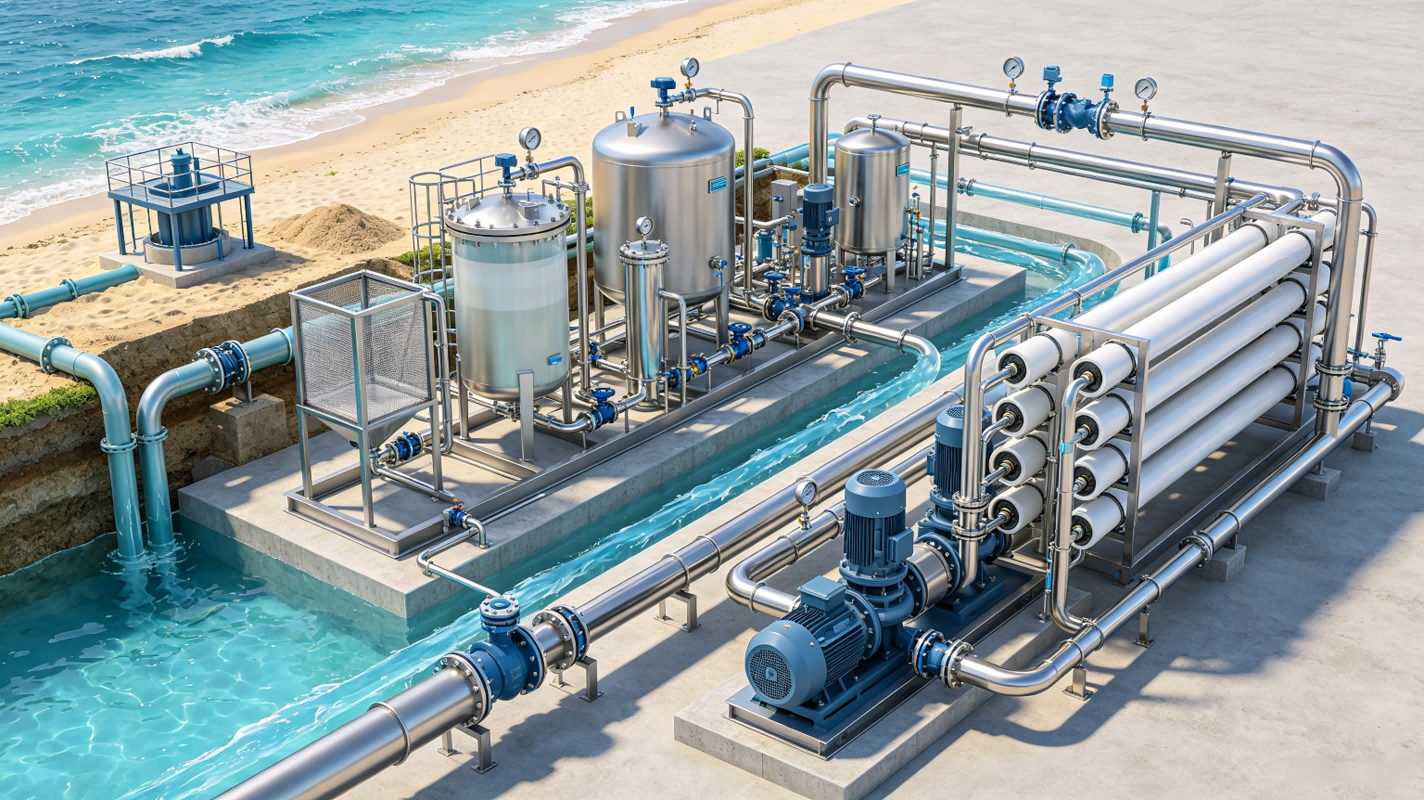
An SWRO intake should be evaluated as a complete hydraulic and water-quality system. The intake structure itself is only one component. Screens, pipelines, pumps, wells, collection systems, monitoring instruments, and pretreatment interfaces all influence the quality and reliability of the feedwater.
| Component | Material Specification | Function | Failure Risk if Compromised |
|---|---|---|---|
| Open-Ocean Intake Structure | Seawater-compatible structural and corrosion-resistant materials | Withdraws seawater directly from the marine environment | Debris loading, organism impingement, unstable intake conditions, excessive solids loading |
| Intake Screen | Material and slot configuration selected for marine exposure | Limits larger debris and organisms entering the intake system | Blockage, increased hydraulic loss, inadequate screening, mechanical damage |
| Beach Well | Well construction and screen materials compatible with groundwater/seawater conditions | Withdraws seawater through permeable coastal formations | Reduced yield, clogging, sand production, unstable well hydraulics |
| Subsurface Collector | Site-specific structural and corrosion-resistant materials | Collects seawater after passage through seabed or subsurface formations | Reduced hydraulic capacity or changes in feedwater quality |
| Intake Pipeline | Seawater-compatible piping selected for hydraulic and corrosion conditions | Transfers raw seawater to pretreatment | Corrosion, leakage, excessive pressure loss, sediment accumulation |
| Raw-Water Monitoring | Project-specific instrumentation | Tracks changes in feedwater quality and hydraulic conditions | Delayed detection of turbidity, algae, pressure, flow, or water-quality changes |
Verify all parameters against current test reports and applicable standards before use in specifications.
Material selection should consider chloride exposure, temperature, hydraulic loading, marine biofouling, mechanical stresses, and the location of each component. The material selected for an exposed intake structure does not necessarily need to be identical to the material used for every downstream component.
For beach wells and other subsurface systems, construction geology becomes an engineering parameter. Grain size, permeability, aquifer thickness, seawater circulation, groundwater interaction, and well development conditions can influence the sustainable intake capacity. These parameters cannot be reliably substituted with generic intake capacity values.
The performance of an SWRO intake should be defined through both hydraulic and water-quality parameters. The objective is to establish what feedwater condition the downstream pretreatment and membrane system will actually receive.
| Parameter | Standard / Reference | Test Method | Acceptable Range | Implication if Out of Range |
|---|---|---|---|---|
| Intake Flow | Project design basis | Flow measurement | Project-specific | Insufficient flow can limit SWRO production and unstable flow can affect process control |
| seawater temperature | Project design basis | Continuous or representative monitoring | Seasonal project range | Affects membrane permeability, viscosity and production capacity |
| Turbidity | Project-specific raw-water specification | Online and laboratory measurement | Project-specific | High turbidity increases pretreatment loading |
| SDI | Membrane/pretreatment design basis | Standardized SDI testing | To be verified for selected membrane design | Higher particulate fouling potential can increase membrane pressure drop and reduce normalized flow |
| Algae / Biological Loading | Project-specific water-quality assessment | Seasonal and event-based monitoring | Project-specific | Can increase pretreatment and biofouling control requirements |
| TOC / Organic Loading | Project-specific water-quality assessment | Laboratory analysis | Project-specific | Can influence organic and biological fouling potential |
Verify all parameters against current test reports and applicable standards before use in specifications.
There is no universal acceptable intake-water range that can be assigned to every SWRO plant. The correct design envelope depends on the selected pretreatment process, membrane configuration, operating conditions, raw-water chemistry, and project water-quality objectives.
SDI is particularly important because particulate matter in RO feedwater can deposit on membrane surfaces and feed spacers, contributing to flux decline, product-water deterioration, and membrane damage. SDI and related fouling indicators are therefore useful when assessing the suitability of intake and pretreatment combinations.
Temperature must also be recorded over the expected operating period. A beach well and an open intake may experience different thermal behavior depending on local hydrogeology and water exchange. The resulting temperature range should be carried into membrane performance calculations rather than treated as an incidental operating variable.
The project information supplied for this article identifies ISO, CE, NSF and domestic qualifications for the manufacturer, but does not provide certificate numbers or complete certificate details. Those documents must be verified before certificate numbers or issuing bodies are inserted into a contractual engineering specification. :contentReference[oaicite:5]{index=5}
The most important engineering consequence of intake selection is the quality of the water presented to the pretreatment and SWRO membrane system. The difference between an open intake and a subsurface intake is therefore not simply a civil-works difference; it changes the contaminant loading and the mechanisms that the treatment train must control.
In an open-ocean intake, the water enters directly from the marine environment. Screen design becomes important because larger solids, debris and marine organisms can reach the intake structure. The intake location also affects the exposure to coastal turbidity, wave-driven sediment, algae and other surface-water variations. Where the raw-water quality changes rapidly, pretreatment may need sufficient process flexibility to maintain membrane feed conditions.
A subsurface intake introduces a different physical mechanism. Water passes through sediment or geological formations before entering the well or collector. This natural filtration can reduce certain suspended and biological constituents and may reduce the intensity of downstream pretreatment. Research on subsurface seawater intakes reports lower algae and bacterial concentrations and lower concentrations of certain organic fractions compared with direct seawater intakes, while also noting that subsurface systems create their own land, beach, geological and hydraulic considerations.
Algae blooms are an important example. In an open intake, an algae event can increase particulate and organic loading before the water reaches pretreatment. The engineering chain can become: algae increase → organic and biological loading increase → pretreatment demand increases → residual fouling potential reaches the RO feed → membrane biofouling risk increases. Pretreatment may therefore require additional screening, coagulation, dissolved air flotation, media filtration or membrane filtration depending on the event severity and source-water characteristics.
With a beach well, part of this loading can be attenuated during subsurface transport. However, this does not mean that a well is automatically immune to biofouling. Biological growth can occur within the well or formation, and clogging, chemical changes, or declining hydraulic conductivity can reduce sustainable yield. The well must therefore be evaluated as a water-production asset rather than treated as a passive filter.
Temperature also enters the intake decision. SWRO membrane permeability changes with temperature, while water viscosity affects hydraulic behavior. If the intake configuration produces a different seasonal temperature profile from the assumed design basis, the downstream membrane system may experience a different production rate or pressure requirement.
Membrane array design is connected to intake quality because pretreatment quality influences the amount and type of material reaching the membrane. A feed stream with higher particulate or biological loading can increase fouling potential across the pressure vessels. Downstream membrane elements already experience higher concentration due to progressive water removal, so additional fouling or concentration polarization can make the final elements particularly sensitive to operating conditions.
Concentration polarization should be distinguished from the bulk-feed salinity measured upstream of the membrane. At the membrane surface, rejected salts accumulate within the boundary layer, creating a local concentration higher than the bulk concentration. This raises local osmotic pressure and reduces the effective driving force for water transport. If recovery is increased without considering the membrane-surface concentration and scaling chemistry, the system can move toward unstable operation.
Boron removal is another downstream consideration. Boron behavior in seawater RO depends on chemical form, pH and membrane characteristics. An intake system that changes the overall water chemistry can therefore influence the design basis for subsequent boron control. If a strict boron limit applies to the final water, the complete treatment train should be evaluated rather than assuming that intake selection alone determines final boron performance.
CIP requirements are also indirectly affected by intake selection. An open intake with higher fouling loading may require more frequent intervention if pretreatment cannot consistently control the membrane feed condition. A subsurface intake may reduce certain fouling loads, but well-related fouling or changes in groundwater chemistry can introduce other maintenance requirements.
The appropriate CIP trigger should be based on normalized membrane performance, differential pressure, permeate flow and salt passage rather than a fixed calendar interval. Once fouling is identified, the cleaning chemistry must correspond to the actual contaminant type. Organic, biological, colloidal, inorganic and metal-oxide deposits do not respond identically to cleaning procedures.
Corrosion control begins at the intake because seawater is present from the first wetted component. Open-ocean structures, intake screens, submerged piping, pumps, valves and fasteners can experience prolonged chloride exposure. Subsurface systems may reduce some direct marine exposure for particular components, but well casings, screens and associated piping still require compatibility evaluation.
For critical seawater-contact components, engineers may need to evaluate stainless steels, duplex or super duplex materials, titanium, FRP and other non-metallic materials according to actual exposure conditions. The selection should consider chloride concentration, temperature, oxygen conditions, crevice geometry, mechanical loading and maintenance access rather than relying on a generic “marine-grade” description.
Finally, intake design is connected to environmental and concentrate management considerations. Direct open-ocean intakes can have marine-organism impingement and entrainment considerations, while subsurface systems can shift part of the engineering burden toward beach, land, geological and hydraulic impacts. Research has specifically identified these differing environmental considerations between conventional open-ocean and subsurface intake systems.
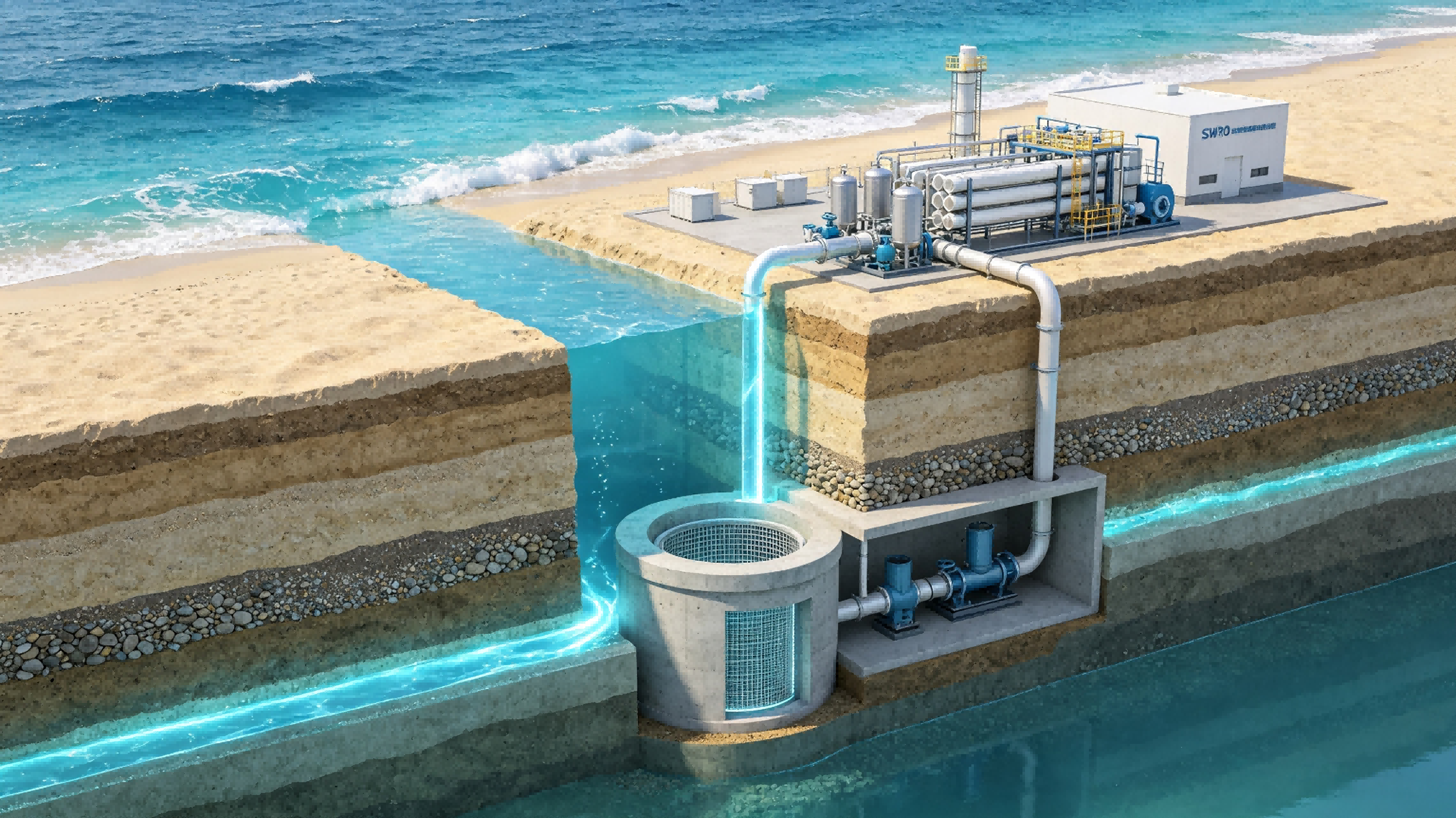
The selection should therefore be based on the whole system: marine conditions, geology, raw-water quality, sustainable intake capacity, pretreatment requirements, membrane performance, environmental constraints, corrosion exposure, maintenance strategy and long-term monitoring.
Failure: Intake flow decreases while hydraulic losses across the intake structure increase.
Root Cause: Marine debris, suspended solids, biological material or other particles accumulate on the intake screen faster than they can be removed.
Engineering Consequence: The available hydraulic capacity falls, potentially reducing feedwater supply to pretreatment and the SWRO system.
Prevention: Screen configuration, cleaning provisions, intake velocity and monitoring should be designed according to the actual marine environment and expected debris loading.
Failure: Pretreatment operates but the SWRO feed still shows elevated particulate fouling potential.
Root Cause: The intake captures a high solids load and the selected pretreatment does not provide sufficient removal under actual operating conditions.
Engineering Consequence: Particles can accumulate on membrane surfaces and feed spacers, reducing normalized permeate flow and increasing pressure drop.
Prevention: Characterize seasonal raw-water quality and establish the pretreatment design from measured turbidity, suspended solids and fouling indicators.
Failure: Well production gradually falls even though the downstream SWRO demand remains unchanged.
Root Cause: Formation clogging, biological growth, mineral deposition, sand movement, or changes in local hydraulic conditions can reduce effective well conductivity.
Engineering Consequence: The available intake flow becomes insufficient for stable plant operation.
Prevention: Well design should include hydrogeological assessment, sustainable-yield testing, appropriate development and monitoring of well performance.
Failure: SWRO differential pressure increases after a period of high algae concentration.
Root Cause: Increased biological and organic loading passes through pretreatment and contributes to biological deposition on membrane surfaces.
Engineering Consequence: Permeate production can decline and membrane cleaning requirements can increase.
Prevention: Open-intake systems should be evaluated against seasonal algae conditions and should have pretreatment and monitoring strategies capable of responding to significant raw-water changes.
Failure: Localized corrosion develops on seawater-contact piping or fittings.
Root Cause: Chloride exposure combined with unsuitable material selection, crevice conditions, surface defects, temperature or mechanical stresses creates localized corrosion conditions.
Engineering Consequence: Leakage, wall-thickness loss, contamination, structural damage or unplanned shutdown can occur.
Prevention: Material compatibility should be evaluated for the actual seawater exposure, temperature and hydraulic environment of each intake component.
Intake Type: Define whether the project uses open-ocean intake, beach well, seabed/subsurface intake or offshore collector well.
Site Conditions: Document bathymetry, seabed conditions, waves, currents, sediment movement and coastal morphology for open intakes.
Geology: For beach wells and subsurface systems, document formation type, permeability, thickness, hydraulic conductivity and sustainable yield.
Raw-Water Quality: Establish salinity, temperature, turbidity, suspended solids, algae, microorganisms, TOC and relevant chemical constituents.
Seasonal Variation: Include seasonal and event-based changes rather than relying on a single water sample.
Intake Capacity: Verify design flow, peak flow, minimum operating flow and sustainable capacity.
Screening: Define screen material, configuration, cleaning method and hydraulic-loss criteria for open intake systems.
Pretreatment Interface: Establish the water-quality envelope delivered from the intake to pretreatment.
SDI Control: Establish the required RO-feed fouling-control target based on the selected membrane and pretreatment system.
Biological Control: Assess algae blooms, biological growth and biofouling potential.
Hydraulic Design: Verify intake pipeline diameter, pressure loss, pump duty and transient operating conditions.
Material Compatibility: Evaluate chloride corrosion and marine exposure for all seawater-contact components.
Monitoring: Specify flow, pressure, differential pressure, turbidity, conductivity, temperature and other project-specific measurements.
Maintenance: Define access for screen cleaning, pipeline inspection, well maintenance and pretreatment servicing.
Environmental Review: Evaluate marine-organism interaction for open intakes and land, beach and geological effects for subsurface systems.
Verification Documents: Require current test reports, water-quality data, drawings, material documentation and applicable certification documents before final specification approval.
Share your project parameters for a technical review.
Qingdao Yanhui Environmental Protection Technology Co., Ltd. provides water-treatment engineering covering research and development, design, equipment manufacturing, installation, commissioning, operation and maintenance; the supplied project information identifies ISO, CE and NSF-related certifications and domestic qualifications, with certificate details requiring verification before specification use.
When evaluating any manufacturer, the technical review should examine whether the supplier can connect intake conditions with pretreatment, membrane design, hydraulic calculations, material selection, instrumentation, cleaning procedures and operating documentation rather than evaluating the RO equipment separately from the seawater source.
The intake determines the physical, biological and chemical characteristics of the feedwater entering pretreatment and therefore influences downstream SWRO design.
Open intakes can experience direct changes in marine water quality, while subsurface systems can provide a degree of natural filtration. DOE identifies both open-ocean and subsurface configurations, including beach wells and offshore radial collector wells, as seawater desalination intake options. :contentReference[oaicite:9]{index=9}
An open intake withdraws seawater directly from the marine environment, while a beach well draws water through permeable coastal formations before it enters the well.
The difference changes the feedwater characteristics and the engineering requirements. Subsurface intakes can reduce certain suspended and biological loads through natural filtration, but their performance depends strongly on geology, hydraulic conditions and sustainable well capacity.
No, a beach well should not be treated as a complete substitute for engineered pretreatment.
Natural filtration can reduce some contaminants, but the resulting water still needs to be characterized for salinity, turbidity, SDI, organic matter, biological activity and other membrane-relevant parameters. The final pretreatment train must be established from actual feedwater data.
An open intake can directly capture seawater during an algae event, increasing biological and organic loading before pretreatment.
If the increased loading is not adequately controlled, it can raise the fouling potential of the RO feed and contribute to biofouling. Pretreatment technologies used in desalination can include coagulation, flocculation, dissolved air flotation, media filtration, microfiltration and ultrafiltration depending on the source-water conditions. :contentReference[oaicite:11]{index=11}
The design basis should include marine conditions, raw-water quality, seasonal variation, required flow, geology where applicable, pretreatment requirements, environmental constraints and long-term maintenance conditions.
For open intakes, the assessment should emphasize marine hydraulics, suspended solids, algae, organisms and sediment conditions. For beach wells or other subsurface intakes, hydrogeology and sustainable well capacity become equally important.
Yes, because the intake influences the type and quantity of contaminants presented to pretreatment and ultimately the SWRO feed.
Higher particulate, organic or biological loading can increase membrane fouling potential if pretreatment does not adequately control it. Cleaning decisions should still be based on normalized membrane performance, differential pressure, permeate flow and salt passage rather than intake type alone.
A seabed or subsurface intake collects seawater through or beneath geological formations rather than withdrawing it directly from the open water column.
The geological formation acts as part of the intake pathway and can provide natural filtration. DOE materials identify subsurface intake as a seawater desalination option and include beach wells and offshore radial collector wells among the configurations considered in desalination systems. :contentReference[oaicite:12]{index=12}
Engineering note: The available project information does not provide site-specific intake capacity, hydrogeological data, raw-water test results, membrane models, certificate numbers or manufacturer-specific intake design values. These parameters should be verified through current project data and technical documents before they are used as contractual specifications.
| Anchor Text | Insert Location | Target Page Type |
|---|---|---|
| Seawater Desalination Equipment | Introduction / H2 1 | Product Page |
| SWRO Membrane Systems | H2 4 | Product Category Page |
| Seawater Desalination Pretreatment | H2 4 | Technology Page |
| Reverse Osmosis Membranes | FAQ | Product Category Page |
Ин вебсайт кукиҳоро истифода мебарад, то шумо таҷрибаи беҳтаринро дар вебсайти мо ба даст оред.
 English
 Portugues
 Pусский
 Français
 العربية
 ไทย
ไทย Indonesia
 Melayu
 Tiếng Việt
 中文
中文 қазақ
қазақ עִברִית
 မြန်မာ
 ພາສາລາວ
 Filipino
 o'zbek
 Кыргызча
 ខ្មែរ
ខ្មែរ Türkmenler



 Телефон
Шарҳ
(0)